Short answer: digitizing a logo for embroidery usually costs about $10 to $50 per design at online digitizing studios (public price lists checked October 2026). Some studios charge by stitch count, often between $1 and $2 per 1,000 stitches with a minimum fee, and others charge a flat rate by size and placement. The price rises with stitch count, design size, fine detail and small lettering. At Vector Design US, embroidery digitizing starts from $10 per design, and the precise figure comes in a quote once we have seen your artwork.
Key takeaways
- Digitizing is a one-time fee for creating the stitch file. Stitching each garment is a separate production cost.
- Per-1,000-stitch pricing follows the size of the design. Flat-rate pricing follows the placement, such as left chest, cap or jacket back.
- Published rates we checked start at $7.50 to $15 for a small, simple design and reach about $49 to $65 for large designs before custom quotes.
- Edits, resizes, rush delivery and extra formats can be priced separately, so read what each quote includes.
- Send clear artwork, the finished size, the garment and the machine format. That is all a digitizer needs to quote accurately.
What does embroidery digitizing cost in 2026?
Digitizing is the job of rebuilding a picture as stitch instructions a machine can follow. A person decides the stitch types, the direction of every fill, the underlay that holds the fabric steady and the order in which colors are sewn. Because that work happens once per design, it is billed once, usually per design.
The table below shows prices that three digitizing providers publish on their own websites. We include it so you can see the spread of prices; it is not a ranking. What is included differs from one provider to the next, such as edits, turnaround and the number of formats, so compare the full offer.
| Provider | Pricing model | Published price | Source (checked Oct 18, 2026) |
|---|---|---|---|
| EMBPunch | Per 1,000 stitches | $1.50 per 1,000 stitches, $7.50 minimum (up to 5,000 stitches), maximum charge $65 | embpunch.com embroidery digitizing |
| EMBPunch | Flat rate by hoop size | Small $11 (under 15,000 stitches, up to a 5 in hoop), complex $20, medium $35 (up to 7 in), large $49 (over 7 in); rush +$2 | embpunch.com embroidery digitizing |
| Digitizing.us | Flat rate by placement | Left chest $15 simple or $25 complex; cap $20 or $30; back $35 or $50; very complex by quote; edit or resize $10 | digitizing.us/pricing |
| Vector Design US | Per design | From $10 per design; exact quote after we review the artwork | Embroidery digitizing service |
A rough pattern shows up across these lists. A small left-chest logo with a few colors usually sits between $10 and $25. Cap designs cost a little more because the curved front and the cap frame need their own stitch plan. Large jacket-back designs land around $35 to $65, and anything with photo-like shading or very fine detail is often quoted one by one.
Per 1,000 stitches vs flat rate: how the two models work
Per-1,000-stitch pricing
The digitizer estimates or counts the stitches in the finished file and multiplies by a rate. At $1.50 per 1,000, a 9,000-stitch logo costs $13.50. A minimum fee covers tiny designs, and some studios cap the total so a very large design does not run away in price.
This model is easy to check, because the stitch count is printed in most embroidery software and machine screens. It rewards small, simple designs. The weak point is that stitch count does not always match effort. A dense fill area adds many stitches but little thinking, while tiny lettering adds few stitches and a lot of careful work.
Flat-rate pricing
Flat rates group designs by placement or hoop size: left chest, cap front, sleeve, jacket back. Within each group there is usually a simple and a complex price. You know the cost before the file is made, which helps when you quote your own customer.
The weak point is the line between “simple” and “complex”. One studio may call a three-color logo with a tagline simple, another may not. Ask how they decide before you compare prices.
Do not confuse digitizing with production pricing
Embroidery shops also use stitch counts to price the stitching of each garment. Wilcom’s help article on embroidery pricing describes the usual stitch-count and quantity table for production, where the cost per 1,000 stitches falls as the order quantity grows. That is the cost of running the machine for every shirt or cap. Digitizing is the one-time cost of making the file those machines run.
| Question | Per 1,000 stitches | Flat rate |
|---|---|---|
| What sets the price? | The stitch count of the finished file | Placement or hoop size, plus a complexity tier |
| Best for | Small logos and simple text | Planned orders where you need the price up front |
| What to watch | Minimum fee, maximum cap, how the count is estimated | Where the line sits between simple and complex |
| Can you check it yourself? | Yes, the stitch count shows in software and on most machines | Partly, by matching your design to the tier description |
What drives the cost of embroidery digitizing?
Stitch count and design size
A bigger design needs more stitches to cover the same shapes. Doubling the width and height of a filled logo roughly quadruples the filled area, so a jacket back always costs more than the same logo on a pocket. Give the finished size in inches or millimeters when you ask for a quote.
Detail and small lettering
Thread has a physical width, so tiny letters and thin lines need a different approach from large shapes. The digitizer may switch from fill to satin stitches, simplify a shape or suggest a minimum text height. Small text is often the slowest part of a design to get right.
Number of colors
Every color change is a stop on a single-needle machine and a needle assignment on a multi-needle one. More colors means more objects to plan, more trims and more sequencing work.
Fabric and garment
A design for a stretchy polo, a fleece jacket, a structured cap or a towel needs different underlay, density and pull compensation. Our guide to embroidery digitizing for different fabrics explains why. A file made for a flat twill patch may pucker on a performance shirt.
Placement
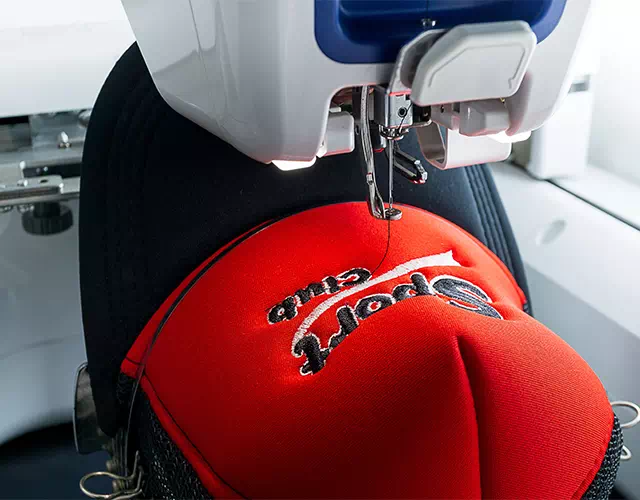
Cap fronts are sewn on a curved frame, so the stitch order usually runs from the center outward. Sleeves and pockets limit the size. Placement affects both the price tier and how the file is built.
Edits and revisions
Some studios include minor edits and charge for bigger ones. Others list a fixed fee for an edit or resize. A file scaled far beyond its original size usually needs rework, because the stitch density does not adjust well on its own.
Want a price for your design?
Upload your logo and tell us the size and garment. We email an exact quote. Digitizing from $10 per design, delivered as DST, PES, EXP or JEF.
How we price embroidery digitizing
We do not publish a fixed price list for every size and tier, because two logos of the same size can need very different amounts of work. This is how common requests compare in our studio.
| Design type | Usual complexity | What raises the price | How we quote |
|---|---|---|---|
| Small left-chest logo or text | Low | Very small lettering, many colors | From $10 per design |
| Cap front logo | Low to medium | 3D puff, small text near the brim, many colors | Exact quote after we review the artwork |
| Patch design | Medium | Fine borders, small text, merrowed edge planning | Exact quote after review |
| Large jacket-back design | Medium to high | Large fill areas, shading, many color changes | Exact quote after review |
| Photo-like or highly detailed art | High | Gradients, faces, textures | Exact quote after review |
Need the opposite direction? If you have a photo of a stitched patch or garment and need clean artwork for printing, that is embroidery to vector conversion, a different service priced separately. If the same logo will also be screen printed, the same artwork can be prepared as separated films through our screen printing art services.


How to get an exact embroidery digitizing quote
A digitizer needs a handful of details to price a design without guessing. Send all of them at once and the quote comes back faster.
- The clearest artwork you have. A vector file is ideal, but a sharp PNG or JPG works. A photo of an existing embroidered item is fine if nothing better exists.
- The finished size. Width or height in inches or millimeters, for each placement.
- The placement and garment. Left chest on a polo, front of a structured cap, back of a fleece jacket, a patch.
- The machine format. For example DST, PES, EXP or JEF. If you are not sure, tell us the machine brand and model.
- Thread colors. Brand and color numbers if you have them, otherwise the closest Pantone or HEX values.
- Any special techniques. 3D puff, applique, or a patch border.
- Your deadline. Standard delivery is 24 hours. A rush as fast as 6 hours is possible, and an extra charge may apply.
How ordering works with us: you upload the artwork and we look it over, then a quote with the exact price arrives by email. After payment by PayPal, Visa or Mastercard, a digitizer begins. Each design includes two free revisions and is covered 100% by our money-back guarantee.
Is a cheap or automatic digitizing file worth it?
Auto-digitizing features in embroidery software can produce a stitch file in seconds. On bold shapes with a few colors, that can be enough. On small text, thin outlines and stretchy fabrics, automatic files often show the same problems: letters that fill in, gaps between colors, puckering and thread breaks.
Auto-digitize it yourself
- Included in many embroidery software packages
- Fine for bold, simple shapes at a larger size
- You need to test-stitch and adjust density, underlay and pull compensation
- Small text and thin lines are where automatic files struggle most
Have it digitized by hand
- A person plans the stitch types, underlay and stitch order
- Exact quote before you pay, from $10 per design
- Delivered within 24 hours as standard, rush on request
- Two free rounds of changes; full refund if it is not right (100% money-back guarantee)
A ruined blank costs money, and on a large order a bad file can cost far more than the digitizing fee. If you want to learn the process, our guide on how to digitize a logo for embroidery walks through the steps, and our overview of embroidery digitizing software compares the tools.
Frequently asked questions
How much does it cost to digitize a logo for embroidery?
On the public price lists we checked, a small, simple logo starts at about $7.50 to $15, a left-chest logo with more detail is around $20 to $25, and large back designs run about $35 to $65. At Vector Design US, digitizing starts from $10 per design, and the exact price is confirmed after we review your artwork.
Is per-1,000-stitch pricing cheaper than a flat rate?
For small, simple designs it often is. For large designs a flat rate or a price cap can work out cheaper. Work out both for your own design before you choose.
Do I pay for digitizing every time I order shirts?
No. Digitizing is a one-time cost per design and size. You pay again only if the design changes, or if it needs to be resized a lot or rebuilt for a very different fabric or placement.
Why does a small design sometimes cost as much as a big one?
Small designs with tiny lettering need careful planning to stitch cleanly. That is why many studios set a minimum fee, and why some quote small but detailed logos above the minimum.
Which file formats are included?
That depends on the provider. We deliver the machine format you need, such as DST, PES, EXP or JEF. Our guide to embroidery file formats explains which machines use which format.
Can a stitch file be resized later?
Small changes are usually fine. Large changes should be redone in the digitizing software, because the stitch density and compensation were set for the original size.
Send your artwork, get an exact digitizing quote
Upload your logo with the size and garment. The exact price reaches your inbox before any stitching plan is made. Embroidery digitizing from $10 per design.
Sources
- EMBPunch, Embroidery digitizing: https://www.embpunch.com/index.php/embroidery-digitizing (checked October 18, 2026)
- Digitizing.us, Pricing: https://digitizing.us/pricing/ (checked October 18, 2026)
- Wilcom, Embroidery pricing (help article): https://help.wilcom.com/portal/en/kb/articles/embroidery-pricing (checked October 18, 2026)
Drafted with AI assistance; facts and prices checked against the sources listed above on October 18, 2026.